


BASIC PRINCIPLES OF DEMOCRATIC GOVERNMENT
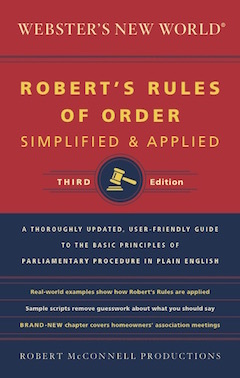
If you are in an organization and need to know more about Robert's rules click here. There is a new chapter in the book especially for HOA's.
BASIC PRINCIPLES OF DEMOCRATIC GOVERNMENT
Organizations, whether they are homeowners associations or the local PTA, have discovered that governments which govern best are those who have laws which protect the rights of those governed and limit the powers of those who govern. In these organizations, members and officers uphold their governing documents. Their meetings are conducted according to the basic principles of democracy as found in a parliamentary authority, like Robert’s Rules of Order Simplified and Applied.
There are six essential principles that ensure that the democratic process is upheld in any organization.
- All members are equal—they have equal rights and responsibilities.
- The organization is run with impartiality and fairness. The rules are applied equally and fairly to all and not just a few. There is no favored group within the organization will get preferential treatment or who considers itself above the law.
- Ideas come from the members and are presented to the assembly to decide upon. Everyone gets the right to present ideas, speak to these ideas, and vote on the ideas, not just a select group...
- The majority rules but the rights of the minority and absent members are protected.
- Everything is accomplished in the spirit of openness, not secrecy. Members have the right to know what is going on within the organization by attending meetings, inspecting the official records and receiving notices and reports form committees, officers, and boards.
- Leaders come from the people through an election process which is fair and not slanted so a favored group can control the organization. When a leader’s term of office ends, he or she returns to the people. A hierarchy of power doesn’t exist; it is shared equally. All members have the right to be considered for office.
Homeowner’s associations need to be very careful in the execution of its affairs because the covenants, bylaws and state codes give a great deal of power to a board of directors or trustees. Instead of being based on the representative government model, HOA’s are based on the corporate business model which gives power to the board instead of to the shareholders. The corporate model allows the shareholders to vote for certain issues that come before the corporation and to elect trustees, but the trustees and CEO do everything else. With this in mind, HOA’s can write their bylaws carefully so that the members [shareholders] can have more input into how business is transacted. How this is done depends on the attitude of those in the HOA and those on the board of trustees. If members are apathetic and want “George to do it” then an HOA will fall in to a category of authoritative government because members have essentially relinquished their rights and given them to others. If the members want to participate in self-government, then the HOA can be more democratic. The board of trustees can decided to have open meetings. It can request the members to submit ideas. The trustees can call special meeting which allow the members to decide important issues instead of letting the board do the entire decision making. Finally, each individual must choose which type of government he wants to live under—authoritarian or democratic.
The most wonderful aspect of democratic government is that it gives members in homeowner associations a structure of impartial laws in which to govern themselves. If wisely followed, these laws preserve both the integrity the property and the friendly relations of those living in the association. This peace is broken when either the officers or the members disobey the documents, whether it is out of ignorance, malice, self-will or disregard the democratic process.
To preserve this peace and the democratic form of government, it is essential that members and officers know:
- what the documents mean. Like congress the members could go over at a meeting the important points in the documents so that they know what is required of themselves and the trustees.
- the rights and obligations of the members and officers.
- how to participate in governing themselves during meetings. Members should know how to make motions, participate in debate without getting angry, and their voting rights. The president should know how to conduct the meetings so he can preserve order and the rights of members to participate.
- what is going on in the association. Members have the right to inspect documents and be informed of the trustees’ activities. And the trustees should be willing to consult the members on important issues for their ideas.
If these recommendations are implemented, a home owner’s association will prosper. The members will begin to work together for good, meet together to come up with viable solutions to maintenance problems, and elect more members to leadership positions. Property values will be maintained and democracy will be firmly established.