


Nominations & Elections - the count goes on
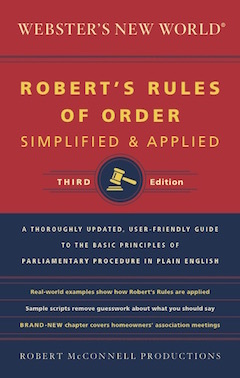
If you are in an organization and need to know more about Robert's rules click here. There is a new chapter in the book especially for HOA's.
Volume 6, Issue 5, December, 2000
drvideo@comcast.net
Volume 6, Issue 5, November/December, 2000
NOMINATIONS & ELECTIONS
And The Count Goes On……
By Robert McConnell Productions
November/December, 2000.
Presidential Recount.
While many are despairing over this entire process, worried that their candidate will not be elected president, many of us are composed, trusting in the democratic system and finding this an invaluable lesson in election procedures.
So what can an organization learn from all of this? Plenty.
1. Adopt election rules.
2. Train the tellers’ committee how to count and report the ballots.
3. Have a ballot that is understandable by all.
4. Have the membership fully informed about how to doubt the results of the vote. If the vote is by voice, they can call for a division. Or make a motion for a rising, counted vote. If the vote is by ballot, then a member can make a motion to recount the vote. However, the best defense is for the organization to adopt rules of order that foresee these problems and have them answered in the rules.
Solving a Problem.
In the spring of this year, a friend called who was very concerned about an election that had happened the prior evening. At the meeting, there was much confusion about who would be elected to an executive board position. After much voting, finally two members received a majority vote and were elected to her church’s executive board. The next morning she received a call from another member stating that it was impossible for one member to get elected. As a member of the executive board, she returned to the church. The Clerk had saved the ballots. In recounting and going over the Teller’s Report she discovered that the Teller’s Committee based the majority on the number of the quorum not on the number of votes cast. The person had not been elected. That is where we came in. The question posed was "Could they have another election? Or should they just let it go." In supporting democracy and the will of the assembly "not letting it go" did not seem like an option. But we needed to some further investigation.
Robert’s states that if the members want to have a recount they need to make a motion. So presumably that should be done at the meeting. However, the problem with this particular organization is that they don’t announce the number of votes cast, or what member has received a certain number of votes. So that put some question as to "how could anyone make the motion for a recount at the meeting?"
But, George Demeter in his parliamentary authority states this on page 249: "When it becomes too late to nullify an illegal election. Until the president-elect or other officer of an illegal election actually takes possession of the office –that is, prior to the time when he is supposed to assume the duties of his office as provided in the bylaws, or before he actually enters into his duties if the bylaws do not specify time—an illegal election may be vacated or voided. It is too late to nullify it after adjournment or after assumption of the office, or when too late to convene a legal meeting to correct it. And if such illegalities occur in conventions or annual meetings in which the opposition slept on its rights, good sense allows them to stand as legal acts after the body has adjourned, on the ground that ‘procedural misfeasance’ or parliamentary wrongfulness cannot be allowed to call another convention."
Now, in this organization, the board members met immediately after the close of the election meeting to elect a chairman and vice-chairman. So it was a done deal. There could not be a new election. So we both learned something. This church however has taken a good look at their procedures and adopted election rules. My friend has given the Tellers’ Committee our book and new video to help them do things correctly.
After solving this, another person called. This time someone had been elected that didn’t meet the eligibility requirements. The Nominating Committee had forgotten to check the bylaws and ask the member if she met the requirements. Since she hadn’t taken office the election could be declared void. But I later found in Demeter’s authority that if a person doesn’t meet the eligibility requirements, then even if they have begun serving, the election is void. P. 347. However, any acts that he makes during his time in office are considered legal.
With two examples and the many questions we receive concerning nominations and elections, it is imperative for each organization to adopt some rules that cover all bases of an election.
Having orderly and legal elections.
In Riddick’s Rules of Procedure, it states "Each organization determines its own method of elections to office. This method should be decided with care. Nominations and elections are vital to the continued well being of any organization. Most organizations include nominations and elections in their bylaws or standing rules, [rules of order in Robert’s] considering them too important to be left to the whim of each administration."
When writing and considering rules for this procedure, let us consider some of the pitfalls and abuses that go on in organizations.
1. The selection of the nominating committee—who selects? If an organization chooses its candidates by this method, then great care should be taken in selecting the committee. Who is selected for this committee will determine who is nominated for office and ultimately what direction the organization will take during the term of office of those elected.
In many organizations just getting people to serve is a feat in itself. But in other organizations, for example, unions, large national organizations, where policy, political divisions and pride of power seem to hold sway, this is a very important committee. Who is nominated determines which faction will run the organization.
The purpose of the nominating committee is to find the best candidates to serve. The people who serve on this committee should be objective and impartial – not letting their own opinions or personal biases hold sway. To protect the democratic process in nominations then, the organization might consider having the membership elect the members of this committee or have part of the nominating committee selected by the membership and perhaps the rest by the executive board. It is never a good policy or practice to have the president select the nominating committee or serve on it. The procedure for selecting the nominating committee should be in the bylaws.
2. Duties of the nominating committee. Alice Sturgis says this about the duty of the Nominating Committee in her book, The Standard Code of Parliamentary Procedure, "A carefully chosen nominating committee should be permitted to use its judgment in selecting the candidates who will give the best service to the organization. It should choose the candidates on the basis of what is good for all the members and not on the basis that an office is a reward to be given to a deserving member. The committee may invite suggestions but should not be limited by them." Then the organization should adopt some standing rules concerning how the committee is to go about selecting candidates:
a. Check to see that candidates selected meet the eligibility requirements.
b. Call the candidates to see if they are willing to serve if elected.
c. If committee members have more than one suggestion for an office, the committee should vote on which candidate to nominate.
d. Members of the nominating committee should not act independent of the committee. Individual members should not go around asking people if they want to serve. It should be discussed in the committee, voted upon, and then one person should be designated to call that person to see if he or she would serve if elected. Standing rules should be adopted to let the committee to know how it is to work in finding the best candidates.
e. The committee should understand what its function is—to find the best people to serve and not favorites or friends of the committee members.
f. The committee should know how to prepare and give the nominating committee report to the members.
3. Handling the nominations at the meeting. The presiding officer should be thoroughly familiar with the nominating process.
a. After the chairman of the Nominating Committee gives the report of the committee – the nominations for each office, the chair then repeats the nominations and asks for nominations from the floor.
b. Any member can give a nomination from the floor. He does not have to rise and address the chair, but can call out from where seated the name of a nominee.
c. A nomination does not need a second.
d. The chair repeats the nomination and asks for further nominations.
e. The chair first gives the name of the nominee of the committee and then asks for nominations from the floor for that office. This is done for each office until all have been completed.
f. The chair can take the vote after each office. Or take all the nominations for all offices first, and then take the vote on each office. This should be established by a rule.
In a democracy, the talents of all members are cultivated, encouraged, with the idea that the best, just like cream, rises to the top. These are who should be considered for office.
ELECTIONS.
After nominations, the members get to decide whom they want for each office by voting. The way the vote is taken should be established by some rule. If the bylaws say the election is to be taken by ballot, even if only one person is nominated for an office the vote must be by ballot. Or the bylaws can state, "Elections shall be taken by ballot. If there is only one nominee for each office, the members by a two-thirds vote, or unanimous consent, can waive the vote by ballot and take the vote by voice." However, members must realize that in a ballot vote they can always write in a name. By waiving this right by a two-thirds vote, the members are giving up the ability to write-in a name. It is also important to understand that a person can be elected without first being nominated. The ballot vote always gives members the opportunity to write in a name of someone who hasn’t been nominated.
There are several ways the vote can be taken – by voice, by show of hands, by roll call, by ballot. The rest of this article will be devoted to taking and counting a ballot vote.
THE BALLOT
As we have seen during this presidential election in Florida, there was confusion in one county to the design of the ballot. An organization should have an election committee that oversees the design, the handing out of the ballot, and the counting of the ballot. This committee can be called an "Elections Committee" or perhaps the "Tellers Committee." Or there could be an "Elections Committee" with a sub-committee entitled "Teller’s Committee" which is responsible for passing out the ballots and counting them. Each organization should decide which is best for it. In small organizations a Teller’s Committee is sufficient.
After the ballot is designed, it should be thoroughly explained to the members including how to mark the ballot. The organization should adopt specific rules concerning the marking of a ballot and what is considered an illegal ballot. This way there will be no question how ballots will be counted or not counted.
The assembly should adopt any rules concerning the conducting of the election, the counting of the ballots, and how the vote will be taken. This prevents a faction from developing within the organization and controlling the election process. It also ensures fairness in counting and recording the votes.
ILLEGAL BALLOTS
First, a legal ballot is one that is properly marked. Second, if a blank ballot and a marked ballot are folded together this is a legal ballot because blanks never count.
Illegal ballots are:
a. One that is not marked correctly.
b. One that has marked two candidates for the same office. How can the teller’s committee tell which one is the preferred vote?
c. One that has two marked ballots folded together. It could be a case of double voting.
d. One that has a written name that is not readable or a name of someone that is not eligible to serve in that office. Sometimes people will not like any candidate and write in "Roy Rogers" or "Mickey Mouse". It could also be the name of someone in the organization that is not eligible to serve because they don’t meet the bylaw requirements for that office.
In our national elections if someone wrote in "Bill Clinton", it could not be a legal vote because he has already served two consecutive terms in office. If some one else wrote in "Queen Elizabeth", this too would be an illegal ballot because she is not a citizen of our country.
In elections in organizations, illegal ballots count in determining the majority, but they are not credited to a person. If there were enough illegal ballots, this could affect an election and if no one received a majority vote then the members would have to vote again. If members aren’t that happy with their candidates then they either should abstain or find someone to nominate that they like.
If the members vote for a slate of candidates, let’s say the president, vice president, treasurer, secretary, board members, if the ballot contains an illegal vote for one of the offices, only that part of the ballot is considered illegal and not the rest of the ballot. Or if a person only votes for the office of president and doesn’t vote for any other candidates, then the vote is counted only for president. The rest of the ballot is considered an abstention.
In counting votes, tellers need to use some common sense. If the members are instructed to put an "x" by the person they want and a member instead puts a "v" or circles the name, then the tellers should count the vote. As long as the person has made his vote understandable, it should be counted. However, if a person writes in a name, and does not designate it by some mark then it may not count. Tellers need to use judgment when deciding how dubious ballots should be counted. For example, if every office is marked with "x" and the write-in isn’t, it probably means that the voter wants the write-in, but just forgot to put an "x" in front of the name.
The best policy is for the chair to thoroughly instruct the members that when they write in a name they also have to put a check by it, or designate it in some way that the write-in is whom they want.
ELECTION IRREGULARITIES
The most important thing that an organization can do is adopt rules that handle the "what ifs" that sometimes come up. These rules should include what to do if an election is challenged and if someone is illegally elected to office and has begun to serve. Rules might include how long ballots are saved, and how long members can wait to challenge an election.
Teller’s should be well trained in counting and recording the votes. There should be enough tellers for the size the organization and the number of votes cast.
Sometimes it happens that more votes are cast then people eligible to vote or present to vote. If this happens the first thing to determine is if someone has arrived at the meeting and not signed in, but voted. The second thing is if some one has put an extra ballot in the box, if the vote does not or can not affect the election, then the election stands.
CHALLENGING AN ELECTION
At this time of great concern in our country, all of us should be looking at our own organization. The question that we need to ask is: Do we have the rules in place to solve and guide us if an election were challenged? If the organization is relying on the parliamentary authority to solve this, the members better look again.
In Robert’s Rules of Order Newly Revised, both the 9th and 10th editions say the same thing. It takes a majority vote to have a recount of a ballot vote. The book states, "After an election has become final as stated in this paragraph, it is to late to reconsider the vote on the election." (After the member accepts the office, it’s too late to reconsider the vote).
Demeter’s Rules of Order is more generous. He also states "When the election has become effective, it is too late to reconsider the vote." However, he does address the issue of an illegal election. On 249 he states this, "Until the president-elect or other officer of an illegal election actually takes possession of the office—that, is prior to the time when he is supposed to assume the duties of his office as provided in the bylaws, or before he actually enters into his duties if the bylaws do not specify time—an illegal election may be vacated or voided. It is too late to nullify it after adjournment or after assumption of the office, or when too late to convene a legal meeting to correct it. And if such illegalities occur in conventions or annual meetings in which the opposition slept on its rights, good sense allows them to stand as legal acts after the body has adjourned, on the ground that ‘procedural misfeasance’ or parliamentary wrongfulness cannot be allowed to call another convention."
And about a recount he states, "Your bylaws should contain full election laws and procedure to cover cases that have arisen in the past and are likely to reoccur; or make them standing rules or convention rules instead. If your bylaws do not prescribe a recount procedure on any issue, the major candidates in issue can agree on one."
In Alice Sturgis’ book on Parliamentary Procedure, she outlines a more detailed procedure for challenging an election. (p. 151)
"An election may be challenged only during the time that it is taking place or within a reasonably brief time thereafter. The grounds for challenging an election are usually that persons who are ineligible have voted, that procedures required for carrying out a fair election were not observed, that procedures or actions during the election were unauthorized or illegal, that there was gross negligence in conducting the election, or that the election requirements in the bylaws were not correctly interpreted or followed and that these violations could have changed the result of the election.
When an election is challenged, an investigation is usually made by the board of directors or by a committee selected by them, or by the elections committee. The board or committee reports its recommendation to the meeting or convention for final decision. If the meeting or convention is no longer in session, the board of directors decides the matter and takes whatever action seems best. The board must report its action to the members.
When an election is challenged while it is in progress, it continues unless a decision is reached to stop the election and declare it void. If it is challenged after it is completed, the officers chosen at the election take office and remain in office until a decision on the challenge is reached.
If it can be proved that enough illegal votes were cast so that the results of the election could have been changed, the election should be voided. If illegal votes cast or illegal practices engaged in could not have changed the results of the election, the fact that there were illegal votes or practices does not void the election."
In Riddick’s Rules of Procedure (written by a former parliamentarian of the US Senate), it states this under "Voting Irregularities", "Challenging the Vote", "The validity of a vote may be challenged by any member as to the results of the tally or the right of another member to vote, to use proxies, or to vote on an issue for personal gain. The chair may rule on such a challenge, ask the credentials committee to submit data, consult the tellers, or ask the assembly to decide. There can be no appeal from the decision of the assembly. A challenge must be made before the vote is to be taken on it or immediately after the result has been announced. The challenge may interrupt a speaker."
As you can see there are several views on the way this is to be handled. The best thing is to decide what is the best procedure for your organization. Write the procedures in the bylaws or rules of order. Then you won’t have to worry about what do when those "what ifs" happen.
VOTING FRAUDS
Yes, these do go on. In all the research that I have been doing on the subject of voting, and there is probably more that I could do, I found that only Riddicks Rules addresses this question. Perhaps this is because he worked in the federal government and was well aware of what goes on. So for prosperity and something to think about here is what he states on the subject.
"Fraudulent votes should be of concern to voters. They violate the will of the assembly and of the people. Fraudulent abuses are easily achieved where the voting monitors and tellers lack integrity and ability. If the votes are illegal or discovered to be illegal ad declared void, they are of no consequence unless they can affect the result of the vote. Some abuses are as follows:
1. Names inserted in registration books of those who have died, who are transients, or are in mental hospitals. A matching signature should be required in an official permanent register book.
2. Paper ballots that are easy to change, erase, or stuff. ‘It ain’t how the ballots go in the counts, it’s how they come out.’ The voter should be sure his or her ballot has been properly deposited.
3. Assistance frauds at voting machines. Such wrongdoers may show the voter how to vote while casting several votes. The handle of the curtain should be closed all the way. All levers on the party emblem sign (voting a straight ticket) should be all the way down and not pushed back up.
4. Voting machines may have wedges inserted to prevent the lever from going down all the way. Labels may be switched. Clocks may be changed to permit fraudulent voters an early vote before hours begin.
5. Setting the machine at a higher figure than zero for a party or an issue.
6. Absentee ballots not delivered in time, miscounted, or otherwise tampered with. Ballots should be carefully sealed.
7. Voters have a right to inspect rolls before or after the voting to check if anyone voted in their name, or if any phony names were added." Riddick’s Rules of Procedure, p.206
Our right to vote is our right to decide. It is important that we value and defend each person’s right to vote and the right that it will be counted. This is how in a democracy we make decisions. In a democracy, we don’t allow one person to rule or a few – the majority rules. So during this time when we are waiting to the see the outcome of this presidential election, may we each defend in our own way the democratic process. It is this process that is fair, impartial and shows the will of the people.
Perhaps we can’t do something about the recount that is going on in Florida, but we can do something to preserve the democratic selection process of candidates in our organizations. Remember, it doesn’t matter whether an election is wrong because of ignorance or fraud, both have the same results. It is up to you, my friend, to become informed, vigilant in protecting this nominating and electing process in your organization, and seeing that the rules are fair and properly enforced.
If you would like to know more about nominations and elections, may we recommend our new video about this subject? Go to our Bookstore on our WEB Site <parli.com>.
Books and Articles used in this article:
Robert’s Rules of Order Newly Revised, 9TH and 10th editions
Parliamentary Law, by Henry M. Robert
Demeter’s Manual of Parliamentary Law and Procedure, by George Demeter, 1969
The Standard Code of Parliamentary Procedure, 3rd edition, by Alice Sturgis, 1988
Riddick’s Rules of Procedure, by Floyd M. Riddick and Miriam H. Butcher, 1985
"Guidelines for Writing Election Rules", by Marjorie Vinzant Weber, PRP, National Parliamentarian, Volume 61, Third Quarter, 2000, pp.23-25
Nominations and Elections, video, by Robert McConnell Productions, 2000.