


Proxy Voting
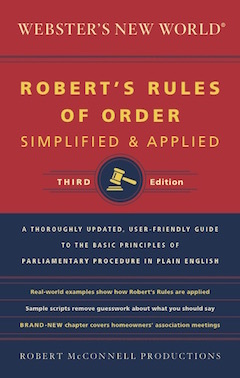
If you are in an organization and need to know more about Robert's rules click here. There is a new chapter in the book especially for HOA's.
By Robert McConnell Productions
Over the last few months we have received calls and emails concerning proxy voting in Homeowners Associations, Condos and other organizations.
Any one who is familiar with Robert’s Rules of Order knows that this procedure is not used in most organizations but only where there is a monetary interest. This news letter will explain what proxy voting is and how to use it properly.
What is a proxy?
The World Book Encyclopedia states that is a substitute. So it is basically one person standing in for another person. In Riddicks Rules of Procedure, it states that “Proxy voting gives the power of attorney to a member to cast the votes for another legal vote holder.”[1] In A dictionary of Procedural Terms, it states that a proxy is “a signed statement authorizing a person to vote in the stead of the signer in the signer’s absence at a meeting.” [2] In a Guide for Voting, it states that “The word proxy has two meanings. One meaning is the power of attorney given to another person to act in one’s stead. The other meaning designates the person who holds the power of attorney. In corporations it is used to allow those who can not attend meetings to send a proxy to vote for them.”[3] A proxy is used in stock corporations and in corporations where members have a monetary interest. Thus it is commonly used in Homeowners Associations and Condo Associations.
How is it granted?
To be able to use a proxy in any organization it has to be granted in the governing documents of the organization or by corporate law. In the Washington State Nonprofit Code, it states that non profit corporations may use proxies but it has to be granted in its corporate charter or bylaws. [4] The Washington State Homeowners act mentions the use of proxies in counting the quorum and voting on certain issues.
Who prepares the proxy?
It is usually prepared by the board and sent out by the secretary with the call to the meeting.[5] It is used whenever the association has some item of business to vote on which includes, but is not limited to, elections, adopting budgets, removing directors, other monetary expenses, assessments increases or decreases.
How many types of proxies are there?
There two types of proxies. One is a general proxy. A general proxy is written in such a way that it gives the proxy holder the right to vote as he or she sees fit on any business that may come up at a meeting. A limited proxy includes on the proxy the business that is to be voted on and a place for the member to tell the proxy holder the way to vote on the business. The proxy holder is legally required to cast the vote the way he has been designated by the member.
What information should the proxy include?
The proxy should include the name of the association, the word proxy under it, and a statement that ____________ is the person’s proxy for the meeting, and then a place for the member to sign and date the proxy. If the proxy is a limited proxy it would also include any issues that are to be voted on at the meeting and a place for the member to check “yes” or “no” or a place to vote for any candidates being considered for office. A proxy also may include when it expires.
Is it possible to have both a general and limited proxy combined?
Yes. It may be desired to do this for an annual meeting. There could be a general proxy for matters that may come up from the members and unknown to the board at the time preparing the proxy. This would give the proxy holder the right to vote however he sees fit. Then there could be a section which is called limited where business is listed, such as motions raising assessments and nominees for office. The state of Florida has such a proxy for Condominiums.
Should a member be allowed to have anyone he chooses be his proxy holder? Or should only members of the association or officers be allowed to hold the proxy?
Here is what Joyce Stephens in her book, Guide to Voting, says about this:
“The proxy holders, if not members of the organization, have no power to vote beyond the proxies they holding. For example, nonmember proxy holders may vote on all questions if the proxy is a general proxy. If the proxy is a limited proxy, they may vote only on all questions listed on the limited proxy. Nonmembers should not have the power to vote on questions of parliamentary procedure during a meeting.
The organization’s articles of incorporation and bylaws should specify that only membersmay be proxy holders, or that only members and the members’ attorneys-at-law may be proxy holders.
Some states have enacted statues relating to the restriction on nonmembers as proxy holders. Organizations may also have a bylaw stating that nonmembers may vote only on matters where the proxies are counted, and may not vote on voice votes or maters of procedures during the meeting.”[6]
What should be of the most concern to any member of an HOA or Condo Association is if the proxy form states that the secretary or another officer will be the proxy holder. This gives too much power to those in office.
When a limited proxy is sent to the members to mark how the proxy holder should vote, is this limited proxy a ballot?
No, the proxy hold needs to receive a ballot just like the members present and cast the ballot as he is instructed by his proxy. This is also true for a general proxy. It entitles the person to vote at the meeting for another.
Is proxy voting a type of voting?
Yes, it is a type of absentee voting and there should be an adopted procedure for writing the proxy, collecting it, verifying it, marking it, and assigning it to an agent. A registered or certified parliamentarian can be of great help in doing this.
Are there problems with using proxies?
There are two big problems. The first is that the members who don’t attend the meeting do not hear the discussion and may have marked their proxy based on misinformation or no information at all. The second problem is that one person can collect many proxies, and if they are general proxies, can influence the outcome of the vote. Members are basically giving their rights away to another to decide for them.
Our company received an e-mail where the proxy was a general proxy for the annual meeting where there was an election of officers. The members were requested to send them in to the secretary if they could not find someone else to give it to. Most of the members in their ignorance sent it to the secretary. Because the secretary received fifty proxies, she ended up deciding who was elected to the board. In true democracies the rule is “one man, one vote.” Because of this situation often happens in HOA’s, the state of Arizona passed a law recently prohibiting the use of proxies and instituting an absentee ballot. It is important for HOA’s and Condo’s to keep up on the changes in their state laws concerning this procedure.
Another way HOA's could handle elections is to do a mail ballot. However, the bylaws need to grant this type of voting, and the association may have to come up with a different way of handling nominations form the floor but that could be done.
Other problems with using limited proxies for elections are that those are not attending do not have the opportunity to consider voting for those nominated from the floor.
Are proxies counted in the quorum?
It depends on whether the bylaws or state laws grant it. Both the Washington HOA Code and the Condominium Act allow for proxies to be counted in the quorum of a meeting. If there is no provision for it in the governing documents then proxies are not counted in the quorum.
Do proxies have a time limit?
Some state laws specific a time limit of ninety days. The Washington State Statues don’t give a time limit. If there is no such provision by state law, then bylaws need to address the time limit in the bylaws, or state on the proxy itself that it is valid for one meeting or expires after ninety days.
In A Guide to Voting, there is an example of a general proxy that is given for the entire term of membership. The author states, “This is a proxy which gives the right to the member’s vote to the corporation for the duration of membership. This type of proxy requires that the member have utmost confidence in the management of the company and the judgment of the board of directors. The term of a proxy of this kind is limited by state corporation laws, and in cases of public companies the Securities and Exchange Commission.”[7] It should not be used in HOA’S and Condo’s.
Can a proxy be used at board meetings?
It is generally assumed that proxies are not valid at board meetings. “In some states, Florida among them, a board or executive committee of a condominium may not vote by proxy or by secret ballot on board matters.”[8]
So check your state laws. In a book entitle, Meeting Procedure for Condominium and Homeowner Associations, it states that “Condominium boards may not vote by secret ballot.”[9]
Can a proxy be revoked?
Yes, by attending the meeting. “An owner may revoke his proxy at any time before the meeting. For example, he may choose to go to the meeting and cast his vote in person. There is always the possibility that he will have changed his preference for any agent.”[10]There should be rules adopted by how a member can revoke his proxy—at the beginning of the meeting or during the meeting.
The most important point here is for members of HOA’s and Condo Associations is to take a sincere interest in the governing of their associations. They should make every effort to attend meetings and be informed about the activities, problems, and operations of the association so that they can cast an educated vote on the business presented at meetings. Government by proxy always results in tyranny.
Here is an e-mail about proxies that we thought you might find interesting.
Spring Hill FL.
My name is Charles and I am a homeowner in a subdivision. The Management Company is requiring that a proxy be signed in order for a ballot to be counted even though the resident will be attending the annual meeting to vote for four Board of Directors.
They (Management Company) also indicate, on the ballot, that one can only write in a candidate after the candidate has been nominated from the floor.
There is nothing in our by-laws that indicate that a proxy is needed, if one is attending the meeting, in order to have the ballot counted.
My questions are:
1. Is a proxy required if I am attending the annual meeting to validate my Ballot?
2. Is a signature required on my ballot?
3. If a write-in candidate must be nominated from the floor, how can one write in his/her name if the ballots have already been mailed in?
I have reviewed Florida State Statute 720 and have found nothing in regards to proxy voting for homeowner associations.
I look forward to your reply and indicating what statutes I might look up on the internet pertaining the above.
Thank you.
Charles
Dear Charles,
I am going to answer you generally and you can apply what I write to your problem. A proxy is used only when someone can't attend a meeting.
Here is some information from a book written by a Professional Registered Parliamentarian about proxy voting. The book is entitled Guide to Voting, by Joyce L. Stephens. She says on page 51, "The word proxy has two meanings. One meaning is the power of attorney given to another person to act in one's stead. The other meaning designates the person who the power of attorney." The purpose of a proxy is to allow members absent to have someone represent them and vote for them. If a member gives his proxy to another and decides to attend the meeting, he has the right to revoke the proxy and vote himself. So usually if you plan on attending the meeting you should not have to send in a proxy.
Perhaps the management company is afraid that there won't get a quorum and that is why it is requiring everyone to sign a proxy just in case the members don't show up. This is what I would be very concerned about if I were you.
1. Is the proxy a limited or general proxy? A limited proxy has on it directions of how the proxy holder is to vote. The general proxy just gives the proxy holder the right to vote and can vote any way the proxy holder wants to vote.
2. Who is assigned to hold the proxy on your form? Is the management company, an officer, or can it be assigned to any member? If a member is allowed to hold the proxy what if they don't come to the meeting?
3. How are they going to make sure that those present get to vote and not say they can't because they signed a proxy?
4. What do your bylaws state, if anything, on this procedure that they are using and about write in candidates? If they bylaws don't handle this, have they adopted special rules of order concerning elections?
5. Do your bylaws state that the vote is taken by secret ballot? Do the bylaws or election rules state that you have to sign your ballot? If not then you don't sign it. If they are concerned about members voting, then they should carry out a procedure like they do with national elections. You sign a register by your name that you have received a ballot, but don't sign the ballot itself.
Another principle about parliamentary law is that your right to write in a candidate can't be taken away from you unless the members have voted to do so in a special rule of order which requires previous notice and a two-thirds vote.
It is difficult to give you specific advice because I haven't seen your documents. I would also ask your board members if the management company has a registered or certified parliamentarian on their staff that is advising them in this matter. And if not, have they read your parliamentary authority on this matter and the state laws.
It sounds like your association and management company could use the advice of a parliamentarian on this. We do offer that service here. We do charge a fee.
Robert McConnell Productions
SAMPLE PROXIES:
The following form was used for our HOA. This was adapted from A Guide to Voting which was taken from Florida Condo, but the state of Florida has something very similar that we believe can be found on the internet. What is interesting about this form is at the bottom it has a “substitute proxy.” If the person assigned to represent the homeowner can’t attend the meeting, then it has a place for that person to assign it to someone who will be at the meeting. The substitute part of the form is not filled out unless the proxy holder can’t make it to the meeting. This proxy has both a general proxy and limited proxy. The limited proxy was only for the election of board members. The general proxy allowed the proxy holder to vote on other items of business that might have been brought from the floor under new business.
CANTA RANA HOA
PROXY FORM
KNOW ALL MEN BY THESE PRESENTS:
The undersigned owners, or their voting representative, of lot No._______in CANTA RANA ESTATES HOMEOWNERS’ ASSOCIATION hereby constitute and appoint the secretary of the association, his designee, or __________________, as nominee, and proxy with powers of substitution for and in the name and place of the undersigned, to appear, represent, and cast votes only as I specifically instruct in reference to the following matters to come before the CANTA RANA ESTATES HOMEOWNERS ASSOCIATION INC. meeting to be held on June 5th, at 7:30pm at City Hall, in downtown Gig Harbor.
General powers (check if appropriate)
______I hereby authorize and instruct my proxy to use his best judgment on all matters which properly come before the meeting as may be authorized by Article III. Section 5. Proxies of the bylaws.
Limited powers (check if appropriate)
_____I hereby specifically authorize and instruct my proxy to cast my vote in reference to the following matters.
Election of Board Members
Please check the name you would like to see elected to the Board of Directors. You can vote for seven people.
_______Dave Anderson _______Janet McConnell
_______Dee Anne Ford _______Robert McConnell
_______Penny Fox _______Ron Morris
_______Mark Grudzien _______Gwen Salisbury
The undersigned ratify and confirm any and all acts and things that the proxy may do or cause to be done in the premises, whether at the meeting referred to above or at any change, adjournment, or continuation, and revoke all prior proxies previously executed.
DATED: _______________
Lot Owner__________________________
SUBSTITUTION OF PROXY
The undersigned, appointed as proxy above, does hereby designate ___________________________
To substitute for me in the proxy set forth above.
DATED: __________________
PROXY________________________________
(In no event shall this proxy be valid for a period longer than 90 days after the date of the meeting for which it was given.)
Here is an example of a general proxy from A Guide to Voting.
PROXY
(Name of Organization)
The undersigned herby appoints___________________________ as my proxy, with full powers of substitution, for all matters to come before the Annual Meeting of the (name of the organization) to be held on (date, and place of meeting), and any adjournment thereof.
_______________________________
Member’s Name
Date______________________________
Here’s another example of a limited proxy from Riddicks Rules of Procedure:
(Name of organization )
I, (name of member, unit of representation , if any) do hereby appoint (name of proxy) to be my true and lawful attorney in fact for me in my name and stead to vote at (name and date of meeting) for (name of candidate selected) for the office of President (or other candidates as have been nominated) (or for yes or no on a particular issue.)
(Written signature of member)
Date _____________________
By searching the internet, you may find other proxy forms that meet your need. If an organization has an attorney or management company, these may also have sample proxie s for an organization to use.
[1]Floyd M Riddick and Miriam H. Butcher, Riddick’s Rules of Procedure,Maryland: Madison books, page 155
[2] Harold Corbin, RP, editor, A Dictionary of Procedural Terms, Indiana, 1996, page 65
[3]Joyce L. Stephens, Guide for Voting, Florida: Fredrick Publishers, 1993 page 51
[4] RCW 24..03.085 Voting.
[5] This is a letter that tells the members there is going to be a meeting and the time, place and purpose of the meeting.
[6] Joyce L. Stephens, PRP, Guide to Voting, Florida: Fredrick Publishers, 1993, page 52
[7]ibid. page 131
[8] Joyce L. Stephens, PRPR, A Guide for Voting, Florida: Frederick Publishers, 1993, page 53
[9]Joyce L Stephens, PRPR, Meeting Procedure for Condominium and Homeowner Associations, Kansas City: National Association of Parliamentarians, 1993,page 86.
[10]Joyce L. Stephens, PRP, Meeting Procedure for Condominium and Homeowner Associations, Kansas City: National Associations of Parliamentarians, 1993, page 38.