


Why do we need to debate a motion?
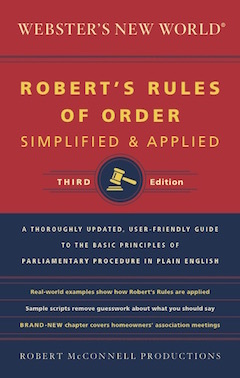
If you are in an organization and need to know more about Robert's rules click here. There is a new chapter in the book especially for HOA's.
By Robert McConnell Productions
Introduction
I recently read an internet blog where: “Pamlico County Commissioner Carl Ollison said a 4-2 vote taken by his board at a budget session Monday shouldn't be allowed to stand because it came as the result of a violation of Robert's Rules of Order. The parliamentary procedural manual governs the board's meetings, and Ollison said its rule on ensuring every board member has a chance to speak on issues up for vote wasn't followed.”
Mr. Ollison and another member of his political party were cut off when someone of the opposing party moved the “previous question,” which means to close debate and take a vote. Evidently this County Commission had some agreement that everyone should be able to discuss the issue before a vote was taken.
Why the need for discussion?
So today we will take up this important question. Why do members need to discuss a motion? And why does the assembly or a board need to hear opposing views?
The purpose of discussion is to get information and not just to hear why someone is in favor or opposed to an idea. That assembly is wise who makes sure that the members have all the information about an issue, both pros and cons, before taking a vote.
I remember one meeting that I attended where I came prepared to vote against an item that was put in the call letter to the meeting, but after listening to the discussion I changed my mind. There were points made that I had not considered. I have also known of cases where a maker of a motion has ended up voting against his own motion because members presented very persuasive evidence that the motion would cause harm to the organization instead of benefiting it.
Discussion or debate not only allows a member to present information, but also allows him to persuade other members to his point of view. If debate is closed too early, or to prevent the opposition from giving its points, the minority is silenced. Valuable information may be suppressed that would be of benefit for others to know.
Henry Robert’s says
In Robert’s Rules of Order Simplified and Applied there is wonderful quote from Henry Robert about debate. He says: “Where there is radical difference of opinion in an organization, one side must yield. The great lesson for democracies to learn is for the majority to give to the minority a full, free opportunity to present their side of the case, and then for the minority, having failed to win a majority to their views, gracefully to submit and to recognize the action as that of the entire organization, and cheerfully to assist in carrying it out, until they can secure its repeal.”
Prosperity of Democracy
Discussion or debate is the prosperity of democracy. It gives the individual member a voice in the organization and an opportunity to make his wishes known to the assembly. When members feel that they have been heard by the others, they are more willing to carry out the wishes of the assembly. Silencing members causes factions, distrust and lack of cooperation. If members continually feel that they are not heard, they will leave the organization and take their talents somewhere else.
And the most important point for everyone to remember is this. Today you may be with the majority. But tomorrow you may be with the minority. So vigorously insist that the rules of debate be carried out in a fair and equal manner. That way all will ultimately win.